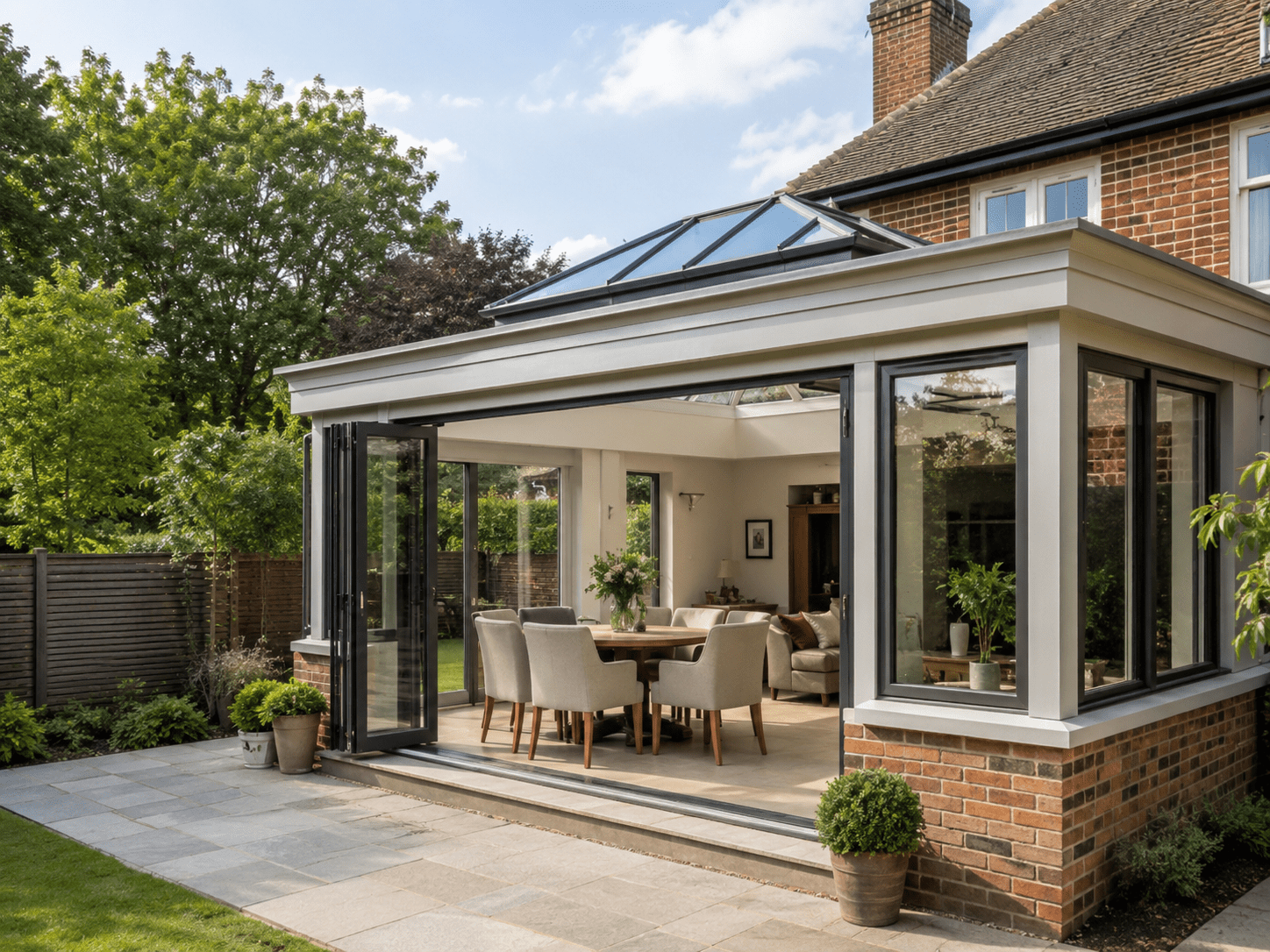
A beautiful orangery does not need to take over your whole garden. In fact, some of the best small orangery ideas work because they solve one clear problem: a dark kitchen, a cramped dining area, or a living space that feels disconnected from the garden.
If you are still comparing sizes, layouts and build rules, our Orangery (UK Guide): Design, Sizes & Build Rules is the best place to start before looking at quotes.
Why small orangeries work so well
Many UK homes do not need a huge extension. A compact orangery of around 3m x 3m can already create enough space for a dining table, reading area or brighter kitchen corner. A slightly larger 4m x 3m layout can work well as a kitchen-diner extension.
The trick is not simply adding floor space. The real value comes from adding light, height and usability.
A roof lantern is often the best solution for this. It brings daylight deeper into the room without needing full glass walls on every side. If the room will be used all year, choose thermally efficient glazing, warm-edge spacer bars and insulated frames. That helps the space feel bright without becoming cold in winter or too hot in summer.
For more detail on this, link naturally to our guide on what is the best roof for an orangery before deciding between a lantern, flat roof or more solid design.
The best uses for a small orangery
A small orangery works best when it has one clear purpose.
Good examples include:
- a kitchen breakfast area
- a compact dining room
- a garden-facing reading space
- a bright home office
- a small family seating area
For a dining layout, allow roughly 900mm around the table where possible, so chairs can move comfortably. For a kitchen orangery, think about where the light enters and whether the new space improves movement between cooking, dining and garden access.
This is where a well-planned orangery extension can feel warmer and more useful than a basic glass-heavy conservatory.
How to avoid making it feel small
The biggest mistake is filling a compact orangery with too much furniture or too many frame lines.
The better solution is to keep the layout simple:
- use one main furniture zone
- avoid blocking the garden-facing glazing
- keep colours light and neutral
- use roof lantern light as the main feature
- choose glazing with good U-values, not just the cheapest glass
If winter comfort matters, read our article on are orangeries warm in winter because the glazing and insulation specification can matter more than the size of the room.
Is a small orangery better than a conservatory?
For homeowners who want a more solid, year-round room, a small orangery can feel more like a proper extension. A conservatory may suit lower budgets or a lighter garden-room feel, but an orangery usually gives a stronger balance of structure, insulation and design.
Our orangery vs conservatory guide explains this difference in more detail if you are still deciding between the two.
Final thoughts
A small orangery can be one of the smartest ways to improve a UK home without overbuilding. Focus on the layout first, then the roof, glazing and insulation specification. A compact design with the right details can feel brighter, warmer and more valuable than a larger space planned badly.
For more project ideas and updates, follow Bestpricevalue.com on LinkedIn.