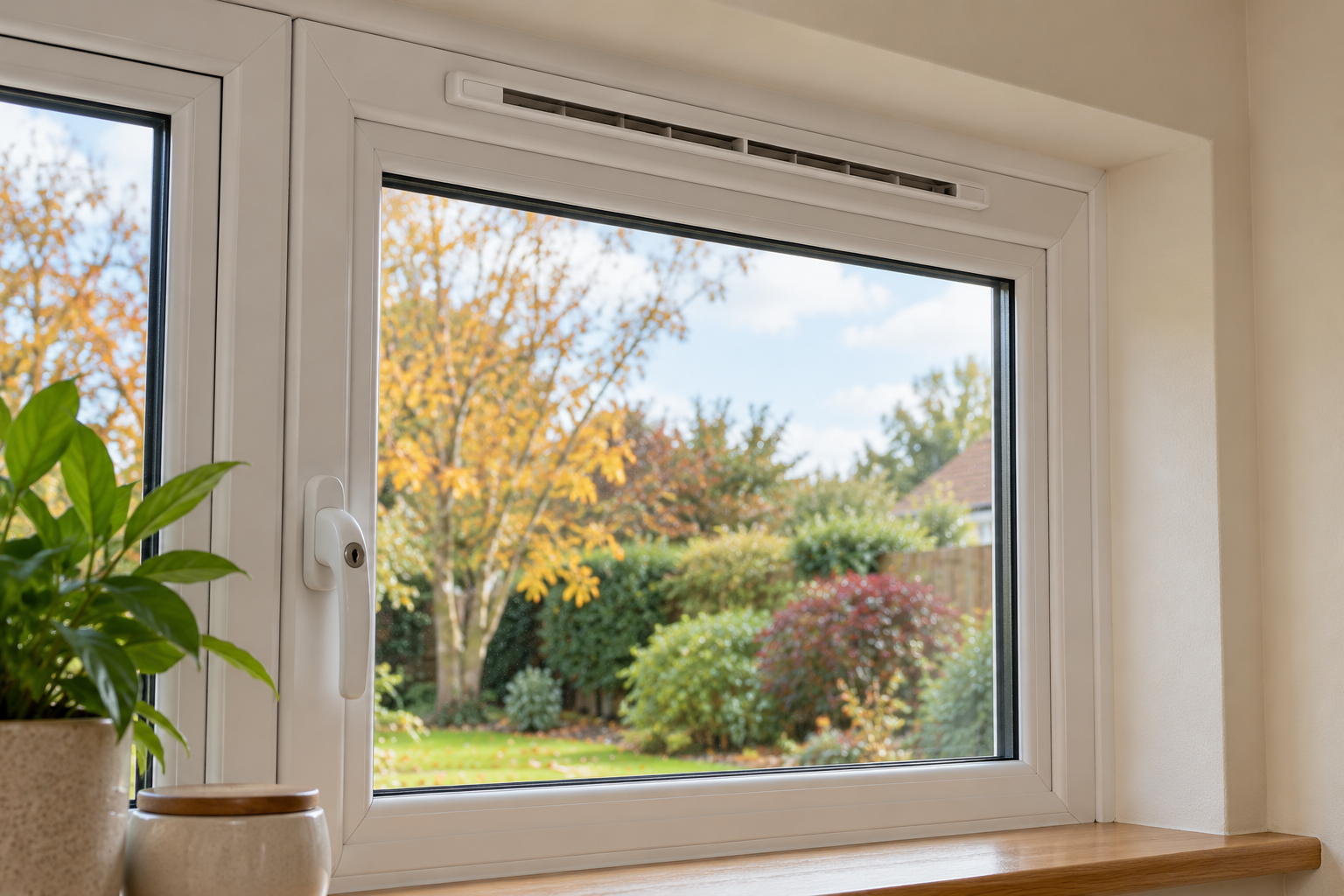
Trickle vents in uPVC windows provide background ventilation while the window is closed. They are a deliberate air route, rather than an accidental gap in a seal. In a naturally ventilated home they will normally be kept open, including in winter, so fresh air can enter while moisture and stale air are removed through the ventilation system.
That can sound surprising when you are buying warmer windows. The aim is to replace uncontrolled draughts with planned ventilation, not make the room airtight at any cost. Before ordering replacement windows, ask how the new windows will work with your home’s extract fans, existing vents and any mechanical ventilation.
In this guide
- What does a trickle vent actually do?
- Do replacement windows need trickle vents?
- Should trickle vents stay open in winter?
- Will vents stop condensation on new windows?
- What about traffic noise and security?
- A practical example: two windows in one bedroom
- What should be included in the window quote?
- Frequently asked questions
What does a trickle vent actually do?
A trickle vent is usually a narrow controllable fitting near the top of a window frame. It allows a limited background air supply without leaving the whole window open. It is one part of a ventilation arrangement: air still needs a route through the home and an appropriate means of extraction.
Background ventilation, extraction and opening a window for rapid airing do different jobs. A vent does not replace the kitchen or bathroom extractor, and a fan cannot work effectively without a suitable air supply. The Energy Saving Trust’s ventilation advice explains why controlled ventilation matters alongside insulation.
Do replacement windows need trickle vents?
In England, replacement-window work must not make the home’s ventilation less satisfactory. The government’s existing home ventilation guide, updated in March 2026, explains that new windows should normally include background ventilators to replace useful air leakage lost when old windows are removed. If useful ventilation is not reduced, that needs to be demonstrated.
There are compliant alternatives in some homes. The Approved Document F FAQs explain that suitable wall ventilators can provide the required background ventilation. An existing wall vent is not automatically sufficient just because it is visible: its purpose and performance need to be assessed.
Ask the installer to record the proposed ventilation route before manufacture. “The old windows had no vents” is not, on its own, an explanation for omitting them from tighter replacements. A homeowner disclaimer is not a substitute for compliance. FENSA’s homeowner guidance also describes why vents are needed in most replacement installations.
This regulatory explanation relates to England. Wales, Scotland and Northern Ireland have their own guidance. The installer should confirm the applicable requirements for your property, including any specialist treatment of a historic building. Do not assume that being in a conservation area gives a blanket exemption.
The 2026 edition of Approved Document F generally takes effect on 24 March 2027 for work in England that is not higher-risk building work, subject to transitional arrangements. Publication does not make it the applicable guidance for every installation today.
Should trickle vents stay open in winter?
For a home designed to use background ventilators, the government guide advises leaving them open and unobstructed even in winter. There is a heating trade-off, but closing every air route can trap the moisture produced by daily living.
If a vent feels uncomfortably draughty, ask whether its position, installation and specification are suitable for the room and exposure. Distinguish air arriving through the intended vent from air leaking around the frame or opening sash. Taping over the vent conceals the symptom without establishing the cause.
Mechanical ventilation systems can have different operating instructions. If your home has a designed whole-house system, follow its instructions and have changes assessed as part of that system. Do not add or remove vents purely on the basis of general advice.
Will vents stop condensation on new windows?
They can help control indoor moisture as part of effective ventilation, but they do not guarantee condensation-free glass. Heating patterns, extraction, moisture sources, cold surfaces and air movement also affect the result. Persistent condensation deserves an assessment of the room and building, rather than an automatic window-replacement quote.
Moisture on the room-side surface is a different issue from misting trapped between sealed panes. If you suspect the latter, ask the glazing supplier to inspect the unit. Our article on condensation in double glazing covers the diagnostic distinctions; this guide focuses on choosing and using the ventilation provision.

What about traffic noise and security?
If reducing road noise is a priority, tell the installer before choosing the glass. A window’s acoustic specification and its ventilation route need to be considered together. Ask about acoustic ventilators and request performance evidence for the proposed arrangement, not just a headline number for one component.
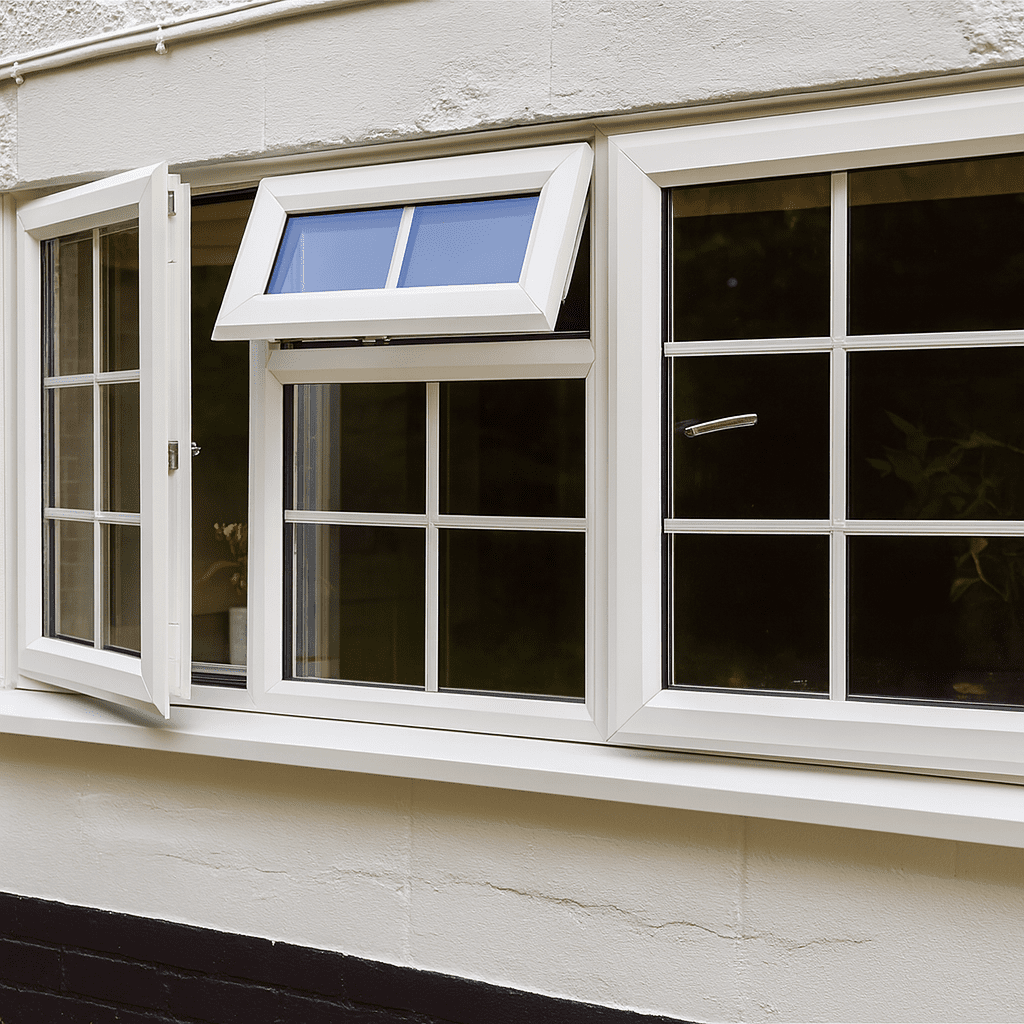
A vent does not need the sash left ajar. England’s Approved Document F FAQs say that a window’s night-latch position is not an appropriate background-ventilation solution because it does not provide a sufficiently secure means of ventilation. Do not treat a locked-looking gap as equivalent to a designed ventilator.
Our guide to acoustic glazing explains the glass and installation questions to discuss alongside the ventilation route.
A practical example: two windows in one bedroom
Imagine a bedroom with two replacement windows. One quotation shows a vent in each frame; another shows ventilation elsewhere in the room. Neither layout can be judged by counting visible fittings alone. The installer needs to assess the room’s required provision and explain how the chosen arrangement delivers it.
Request the ventilator model, declared equivalent area and location. Equivalent area is a measure of airflow performance; it is not simply the physical size of the plastic cover. Avoid choosing a tiny fitting because it looks discreet without checking whether it provides the intended ventilation.
The useful question is: “How does this room receive and remove air after the replacement?” That is more informative than asking whether every window must have the same vent.
What should be included in the window quote?
Ask for the window system, glazing, opening arrangement and ventilation specification in the same written quotation. Check the vent’s colour, location, control and cleaning access as well as its performance. If noise is a concern, add that to the brief and ask what evidence supports the recommendation.
Confirm who checks existing extraction and whether any additional ventilation work is included. Request the full installed price, VAT, removal, making good and exclusions. An apparently cheaper window quote may leave the ventilation solution unspecified.
For an indicative glazing budget, use our Double Glazing Cost Calculator. It does not design a ventilation system. You can request quotes once your project brief includes both comfort and ventilation needs.
Frequently asked questions
Can I close trickle vents at night?
In homes designed to use background ventilators, they should normally remain open, including overnight. Follow the instructions for your ventilation system and ask for an assessment if noise or draughts make them difficult to use.
Do all replacement windows need their own trickle vent?
Not necessarily. Provision is assessed as part of the room and home’s ventilation arrangement. Ask the installer to explain the compliant solution rather than relying on a count of fittings.
Can a wall vent replace a window trickle vent?
In England, an appropriately specified wall ventilator can provide the background ventilation described in Approved Document F. Its purpose and equivalent area must be checked; not every existing grille is suitable.
Are trickle vents the same as a night-vent window position?
No. A trickle vent provides a designed air route while the sash is closed. A night-latch position leaves the sash slightly ajar and is not an appropriate background-ventilation solution under England’s Approved Document F guidance.
Do the published 2026 ventilation standards apply to every replacement now?
No. The 2026 edition of Approved Document F has commencement dates and transitional arrangements. Your installer must confirm which guidance applies to the building work, rather than treating publication as immediate application.
For more practical home improvement advice, follow Bestpricevalue.com on Facebook.