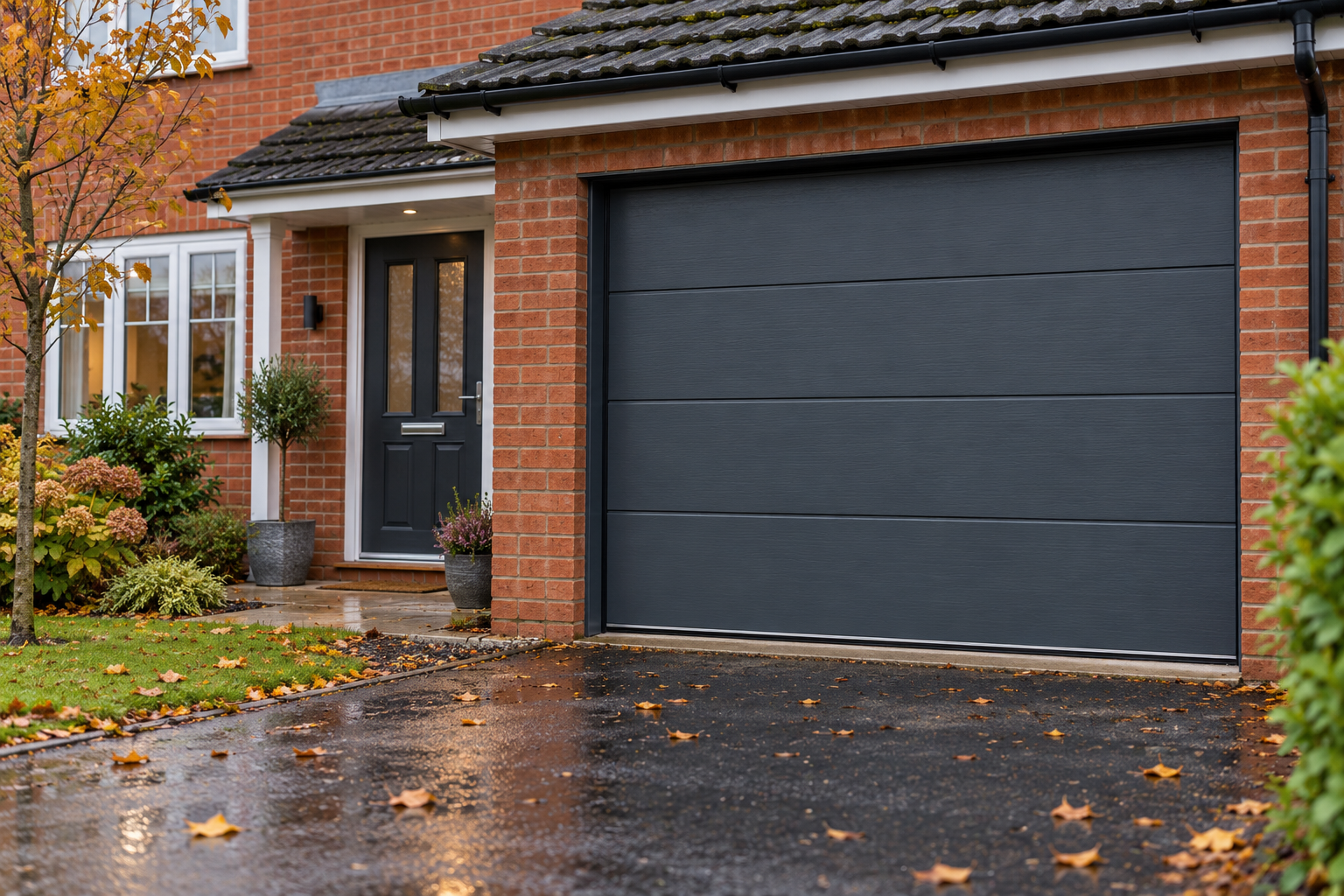
Insulated Garage Doors are most worth considering when the garage is attached to the house, used regularly, or needs a more comfortable working environment. For a detached garage used only for parking, the extra cost may be harder to justify. The right decision depends on the whole building, how you use it and the complete door specification—not just the thickness of its panels.
Insulation slows heat transfer; it does not generate heat or turn a basic garage into a habitable room. Start with the garage’s purpose, then compare documented performance and installed prices. Our overview covers the wider choices of opening style, material and automation.
In this guide
- When does an insulated garage door make sense?
- Whole-door U-values versus panel U-values
- Sectional, roller or side-hinged: which should you compare?
- Why seals and installation matter
- Will insulation stop condensation or make the garage warm?
- How should you judge the extra cost?
- What should your installed quote state?
- Frequently asked questions
When does an insulated garage door make sense?
For an attached garage, consider how it meets the house: an internal doorway, shared walls and a room above can all affect the priorities. A better external door is one possible improvement, but the separation between garage and house also matters. It is worth asking where heat is being lost before concentrating the whole budget on the garage entrance.
A workshop used for several hours at a time presents a different brief from a place used briefly to park a car. You may value reduced draughts and a less exposed interior even without a guaranteed reduction in household energy bills.
For a detached storage garage, security, reliable operation and weather protection may be more important than a premium thermal specification. Tell suppliers what is stored and how the space is used rather than accepting the same recommendation for every property.
| Garage use | What to prioritise |
|---|---|
| Attached to the home | Door performance and the separation from the house |
| Regular workshop use | Comfort, seals and the rest of the garage fabric |
| Detached parking only | Weather protection, operation and security; judge the insulation premium separately |

Whole-door U-values versus panel U-values
A U-value expresses heat transfer through a construction in W/(m²K). Lower values indicate less heat transfer when the area and conditions are comparable. A figure for the middle of an insulated panel does not describe the complete fitted door, which also includes joints, edges and frame details.
Compare a whole-door U-value with another whole-door U-value, rather than with a figure for the centre of a panel. Joints, edges and the frame also affect the complete door’s performance. Ask the supplier to identify exactly what each declared figure covers.
Request the whole-door value and the size and configuration it describes. Check whether glazing, ventilation openings, frame upgrades or a different door size change the declared result. A performance figure without these details makes two quotes difficult to compare.
Sectional, roller or side-hinged: which should you compare?
Insulated sectional doors use connected panels and usually run on internal tracks. Insulated roller doors use smaller interlocking slats that coil into a box. Side-hinged insulated products are also available. The style describes how the door operates, not a guaranteed level of insulation.
Compare the actual product and its documented performance. Two doors marketed as “insulated” may have different panel construction, edge details and air leakage. Do not assume that adding foam to an otherwise basic door recreates the performance of a complete factory-designed system.
Usability belongs in the same decision. Check headroom, side space, ceiling storage and pedestrian access. A thermally impressive product that conflicts with a beam or obstructs everyday access may not suit the garage.

Why seals and installation matter
Insulation and draught control are related but different. A panel can resist heat transfer while a gap at the bottom still lets cold air pass through. Ask how the door will meet the floor and how the sides and top are sealed. An uneven floor deserves attention at survey rather than a last-minute promise to make the seal fit.
Weather protection also depends on the site. A sloping driveway can direct water towards the opening, and a new bottom seal is not a substitute for dealing with unsuitable drainage. Ask the installer to explain the cause if the old door admits water.
Get clear responsibilities for adjustment after fitting. If the door begins to rub, stops sealing or needs repeated opener adjustment, you should know whom to contact and whether that work is covered.
Will insulation stop condensation or make the garage warm?
Not by itself. A garage can still have cold walls, an uninsulated roof or moisture arriving with a wet car. Sealing uncontrolled gaps without assessing ventilation can leave moisture problems unresolved. Keep purpose-designed ventilation available and ask for a whole-garage assessment if condensation is persistent.
Where heating, ventilation equipment or an appliance is present, do not cover its air routes to improve comfort. Explain the existing arrangement to the supplier so the proposed door does not interfere with it.
If the intention is to convert the garage into living space, that is a different project from replacing its door. Discuss the conversion requirements, fabric, ventilation and approvals with the appropriate professionals. A new insulated door alone does not establish that the space is suitable for occupation.
How should you judge the extra cost?
Ask for two versions of the same brief: a suitable standard door and a suitable insulated alternative. Hold the opening size, finish, operation and installation scope constant wherever possible. Otherwise, an apparent insulation premium may include a motor, different colour or substantial building work.
For example, suppose one hypothetical installed quote is £1,800 and another is £2,400. The £600 difference is useful only after you know what each includes. If the second adds electric operation as well as insulation, it does not measure the price of insulation alone. These amounts illustrate quote comparison; they are not current market prices.
Be cautious of a fixed payback promise. Heating use, the rest of the garage, weather and the connection to the house determine what any saving might mean. Comfort, usable space and improved sealing may be part of the value even where a reliable annual saving cannot be calculated.
What should your installed quote state?
Request the exact model, opening size, insulated construction, whole-door U-value and reference configuration. Add the sealing arrangement, operation, safety provision for a powered door, fitting work and any repairs to the opening.
Check whether electrics, old-door removal, making good, VAT, remotes and servicing are included. Separate the door, opener and finish guarantees; they may have different terms. The installer should confirm the intended service intervals and demonstrate safe operation and manual release where relevant.
Use our Garage Door Cost Calculator for an indicative starting budget, then request quotes for your actual specification. A calculator estimate cannot verify a product’s thermal performance.
Frequently asked questions
Are insulated garage doors worth it for a detached garage?
They may improve comfort for regular use, but the case is weaker for an unheated detached garage used only for parking. Compare the extra installed cost with your priorities for weather protection, security and everyday use.
Will an insulated door heat my garage?
No. Insulation slows heat transfer but does not create heat. The walls, roof, ventilation and any heating also affect the temperature.
Is a panel U-value the same as the whole-door U-value?
No. A panel figure describes only part of the product. Ask for the complete fitted door’s value, including the stated size and configuration.
Are all roller garage doors insulated?
No. Construction and performance vary by model. Ask for the exact product specification rather than relying on the roller opening style.
Will replacing the door cure condensation?
Not necessarily. Moisture, cold surfaces and ventilation need to be assessed together. A better door may help one aspect of comfort without resolving the underlying moisture problem.
For more practical home improvement advice, follow Bestpricevalue.com on Facebook.