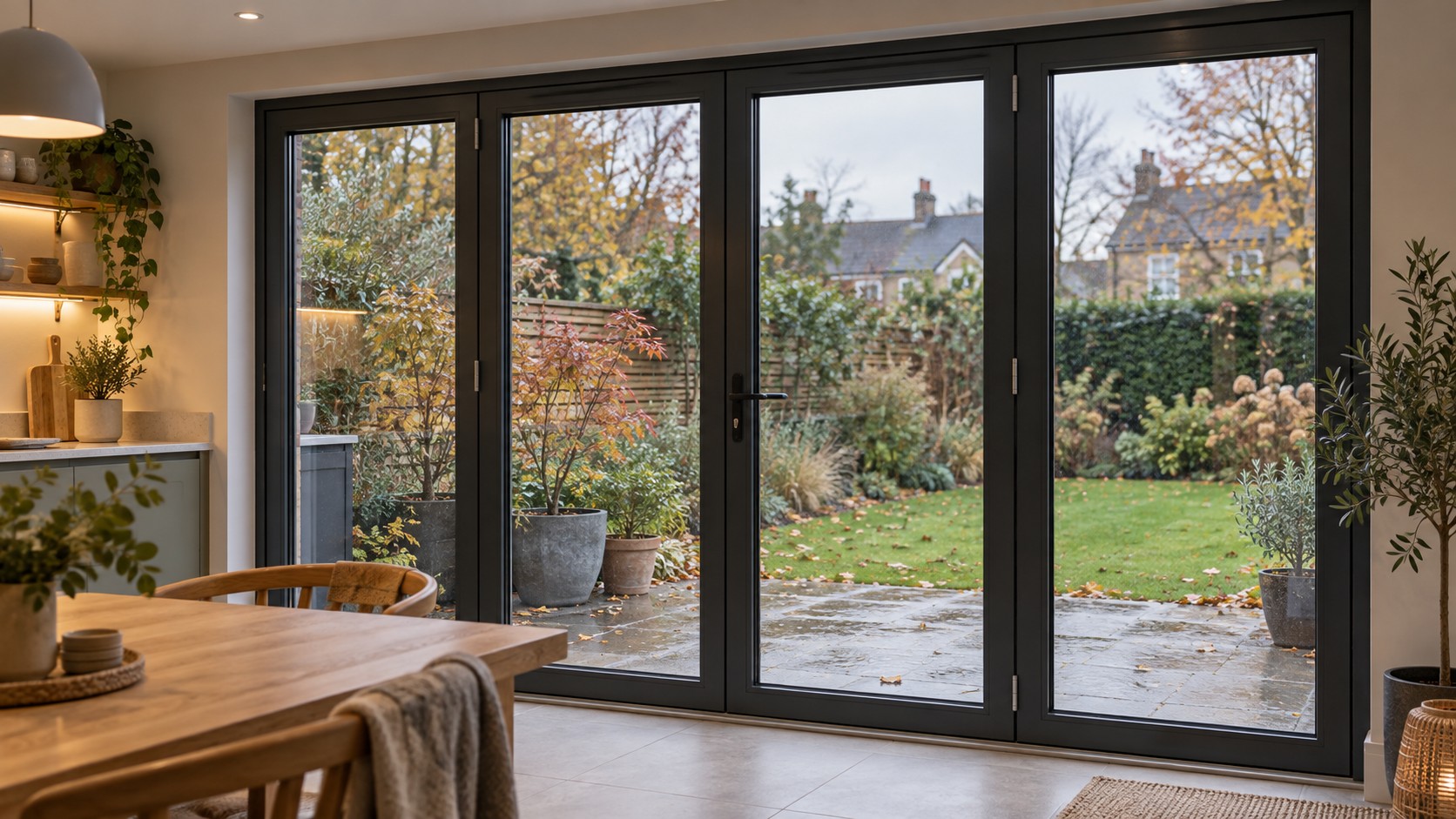
Bifold door U-values tell you how readily heat passes through a closed door set. A lower number means less heat loss through the doors, but the figure needs to cover the complete frame and glazing. A glass-only value cannot tell you how the finished doors will perform.
If you want a bright kitchen extension that also feels comfortable in winter, compare the thermal specification before choosing a frame colour or panel layout. This guide explains what the numbers mean, which questions to ask and how to avoid comparing two different measurements.
For opening styles, materials and wider buying decisions, start with our Bifold Doors UK Guide.
In this guide
- What does a bifold door U-value mean?
- Whole-door U-values versus glass-only values
- What is a good U-value for bifold doors?
- Building Regulations: current and forthcoming guidance
- Frames, double glazing and triple glazing
- Draughts, installation and summer comfort
- A simple heat-loss example
- What to check on your quote
- Frequently asked questions
What does a bifold door U-value mean?
A U-value measures heat transfer, expressed in watts per square metre per degree of temperature difference: W/(m²K). With the same door area and indoor-to-outdoor temperature difference, a lower U-value means less heat passing through the door construction.
For example, a door set rated at 1.0 W/(m²K) loses less heat through its construction than one rated at 1.4 under the same conditions. Neither number tells you the total heating bill, how draughty the installation is or how much afternoon sunshine the room receives.
Think of the U-value as one part of the specification. You still need weather protection, reliable seals, an appropriate threshold and a good installation.
Whole-door U-values versus glass-only values
One of the easiest mistakes is comparing a supplier’s glass figure with another supplier’s complete door figure. Ask each installer to identify exactly what their quoted number covers.
- Ud: the whole doorset U-value, including glazing, frame and the relevant edge effects.
- Ug: the glazing U-value. This describes the glass unit rather than the complete doors.
- Uf: the frame U-value. It is also only one component of the finished system.
A quote advertising Ug 1.0 does not necessarily offer a whole-door Ud of 1.0. The frame and the junction around the glazing affect the overall result. BRE’s U-value calculation guidance makes the same practical distinction: obtain the value for the complete doorset.
Also check whether a brochure’s headline figure describes a reference size, a particular glazing upgrade or your actual order. Changing the door dimensions and number of panels changes the balance of glass, frame and edges. Ask for written confirmation that the declared performance applies to the specification being supplied.
What is a good U-value for bifold doors?
A good starting point is the performance required by your project, followed by the improvement available within your budget. There is no single number that makes every bifold door the right choice for every home.
For a like-for-like comparison, request whole-door figures for the same opening size, panel arrangement, glazing and threshold. If one option offers 1.4 and another 1.2 or 1.0 W/(m²K), the lower figure indicates better resistance to heat loss through the doors. These are comparison examples, not a promise that every product or configuration achieves them.
Ask what the upgrade costs and what changes to achieve it. A cheaper set with a clear specification and good fitting arrangements may be easier to assess than a vague premium quote promising only “high-performance glass”.
What do Building Regulations say about bifold door U-values?
For England, Table 4.2 of Approved Document L, Volume 1, 2021 edition incorporating 2023 amendments gives a limiting U-value of 1.4 W/(m²K), or a minimum Doorset Energy Rating of band C, for new or replacement doors in existing dwellings with more than 60% of the internal face glazed. Replacement performance should also be no worse than the existing element.
This is not a universal specification for every new-build or extension design. An extension’s overall glazing area and energy assessment can affect what is acceptable. Ask your designer or building control professional to confirm the route for your project.
The 2026 Approved Document L has been published, but generally takes effect on 24 March 2027 for work in England that is not higher-risk building work, with transitional arrangements. Publication does not make it the applicable standard for every project now. Scotland, Wales and Northern Ireland have separate guidance.
What makes bifold doors more energy efficient?
Thermally broken frames
In an aluminium system, a thermal break separates the inner and outer metal sections with a less conductive material. Its design helps limit heat transfer through the frame. Ask for the whole-door result instead of assuming that all aluminium frames perform alike.
Frame material alone is not a performance certificate. Compare the documented system you are buying, including the glass and panel arrangement.
Low-E glass, gas fills and warm-edge spacers
Low-emissivity glass uses a coating to reduce heat transfer. Gas-filled cavities and warm-edge spacers can also improve an insulated glazing unit’s performance. The Energy Saving Trust’s guide to efficient glazing explains these features and why the frame matters alongside the glass.
Ask the installer to list these components on the quotation. The phrase “double glazed” on its own leaves too much unspecified.
Is triple glazing worth it for bifold doors?
Triple glazing can reduce heat loss further, but compare the resulting whole-door U-value and the additional installed cost. Do not assume an extra pane automatically makes every triple-glazed system better than every double-glazed alternative.
Ask whether the proposed panels, rollers and hinges are designed for the specified glazing weight, and try the doors in a showroom if possible. Request separate prices for the double- and triple-glazed versions of the same system. That makes the thermal benefit and practical trade-offs easier to judge.
Why draughts and installation matter as well
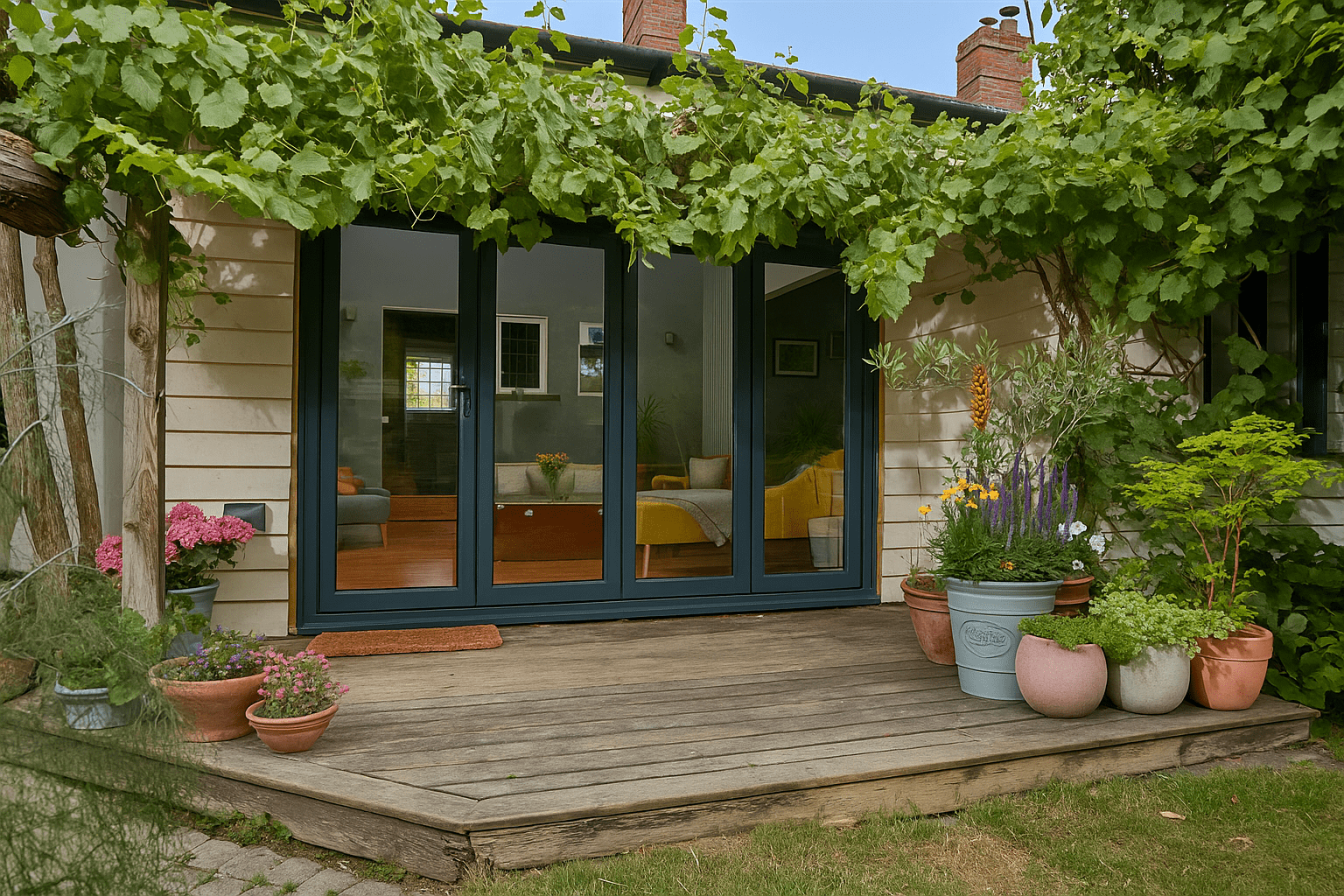
A low U-value does not compensate for an unsealed gap around the frame. Heat passing through the door construction and air leaking around the installation are different problems.
Ask how the installer will insulate and seal the perimeter, align the panels and check the gaskets. Confirm that the specified threshold has the weather performance needed for the exposure of your property. Our bifold door threshold guide explains the access and weatherproofing decisions in more detail.
If existing bifolds feel cold, have the installer check alignment, seals and fitting before assuming all the glass needs replacing. Keep intended ventilation and drainage routes clear; blocking them is not a sound draught-proofing solution.
Does a low U-value prevent summer overheating?
No. The U-value concerns heat transfer through the construction. The glass g-value describes the proportion of solar energy passing through it. A well-insulated door set can still admit significant sunshine into a south- or west-facing room.
Consider shading, ventilation and solar-control glazing alongside winter insulation. Our guide to solar-control glass for bifold doors covers this separate comfort decision. Ask for both figures rather than treating “energy efficient” as a complete specification.
How much difference can a lower U-value make?
Here is a simple illustration, not a heating-bill forecast. Assume a closed doorset has an overall area of 6 m² and the indoor temperature is 20°C higher than outdoors.
- Ud 1.4: 1.4 × 6 × 20 = 168 watts of heat transfer.
- Ud 1.0: 1.0 × 6 × 20 = 120 watts of heat transfer.
- Difference: 48 watts, or approximately 29% less heat transfer through that doorset under those conditions.
This does not mean a 29% reduction in household energy bills. Real use also involves changing weather, solar gains, air leakage, heating efficiency, the rest of the building and how often the doors are open. Use the example to understand the numbers, not to calculate a guaranteed payback period.
What should you check before accepting a quote?
Send each installer the same brief and request the following in writing:
- The manufacturer and exact door system.
- The overall dimensions, number of panels and opening arrangement.
- The whole-door U-value, its units and supporting calculation or test documentation.
- Confirmation of whether the figure is for your configuration or a declared reference configuration.
- The glazing build-up, low-E coating, gas fill and spacer specification.
- The glass g-value where solar gain is a concern.
- The threshold, weather performance and installation sealing details.
- The full installed price, including VAT, removal, making good and any exclusions.
- The guarantee and who handles adjustment or sealing problems after installation.
For a broader installation checklist, read what to check when buying external bifold doors.
You can also use our Double Glazing Cost Calculator as a starting point for glazing budgets. Its estimates are indicative, not a thermal-performance assessment or a final installer quotation. For bifold options and quote enquiries, visit our bifold doors.
Frequently asked questions
Is a lower bifold door U-value better?
Yes, for heat loss through a comparable closed doorset. Compare whole-door values for equivalent specifications. Also assess air leakage, installation and solar gain.
Is 1.4 a good U-value for bifold doors?
A whole-door value of 1.4 W/(m²K) is a useful reference point, but suitability depends on the project and applicable guidance. Lower values offer better insulation under equivalent conditions. Check the regulations section above with your installer or designer.
Is the glass U-value the same as the door U-value?
No. Ug describes the glazing, while Ud describes the complete doorset. Ask for the whole-door figure rather than relying on a glass-only number.
Do bifold doors have to be triple glazed?
There is no blanket rule that every bifold door must be triple glazed. The complete system must meet the requirements of the project. Ask for evidence of the proposed doorset’s performance.
Will better U-values stop condensation?
They do not guarantee condensation-free glass. Indoor humidity, ventilation, outside conditions and cold spots also matter. Persistent moisture between sealed panes should be assessed by the supplier.
Can I compare bifold and sliding doors using U-values?
Yes, if both figures cover the complete systems and equivalent sizes and glazing. Also compare their opening arrangements, weather performance and installation details.
For more practical home improvement advice, follow Bestpricevalue.com on Facebook.